JavaScript is disabled for your browser. Some features of this site may not work without it.
Mostrar el registro sencillo del ítem
| dc.creator | Ruiz-Monachesi, Mario R. | |
| dc.creator | Cruz, Félix B. | |
| dc.creator | Martínez, Juan J. | |
| dc.date | 2025 | |
| dc.date.accessioned | 2026-06-17T19:16:41Z | |
| dc.date.available | 2026-06-17T19:16:41Z | |
| dc.identifier.issn | 2396-9814 | es_ES |
| dc.identifier.uri | https://rdi.uncoma.edu.ar/handle/uncomaid/19469 | |
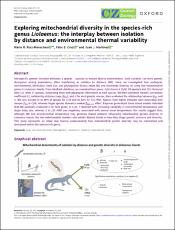
| dc.description.abstract | Intraspecific genetic variation enhances a species´ capacity to endure diverse environments. Such variation can drive genetic divergence among populations, often manifesting as isolation by distance (IBD). Here, we investigated how ecological, environmental, life-history, body size, and phylogenetic factors shape IBD and nucleotide diversity (π) using two mitochondrial genes in Liolaemus lizards. From GenBank database, we examined two genes: Cytochrome b (Cytb; 88 species) and 12S ribosomal RNA (12S rRNA; 37 species), integrating them with geographic information of each species. We then estimated Mantel’s correlation coefficient (r), isolation-by-distance slope (βIBD), and π for each genetic marker, then evaluated the relationship between βIBD and π. IBD was present in 55.40% of species for Cytb and 42.42% for 12S rRNA. Species from higher altitudes were associated with steeper βIBD in Cytb, whereas larger species showed a weaker βIBD-Cytb effect. Bayesian generalized linear mixed models indicated that IBD positively explained π for both genes. In Cytb, π declined with increasing variability in environmental temperature and larger body size, whereas π in 12S rRNA was negatively associated with annual mean temperature. Our results suggest that, although IBD and environmental temperature may generate shared patterns influencing mitochondrial genetic diversity in Liolaemus lizards, the two mitochondrial markers also exhibit distinct trends in how they shape genetic structure and diversity. This study represents an initial step toward understanding how mitochondrial genetic diversity may be maintained and structured within this species-rich genus. | es_ES |
| dc.format | application/pdf | es_ES |
| dc.format.extent | pp. 1-18 | es_ES |
| dc.language | eng | es_ES |
| dc.publisher | Oxford University Press | es_ES |
| dc.publisher | Zu-Shi Huang | es_ES |
| dc.relation.uri | https://doi.org/10.1093/cz/zoaf075 | es_ES |
| dc.rights | Atribución-NoComercial-CompartirIgual 4.0 | es_ES |
| dc.rights.uri | https://creativecommons.org/licenses/by-nc-sa/4.0/ | es_ES |
| dc.source | Current Zoology, 2026 | es_ES |
| dc.subject | Body size | es_ES |
| dc.subject | Environmental heterogeneity | es_ES |
| dc.subject | Intraspecific variation | es_ES |
| dc.subject | Reproductive mode | es_ES |
| dc.subject.other | Ciencias de la Tierra y Medio Ambiente | es_ES |
| dc.title | Exploring mitochondrial diversity in the species-rich genus Liolaemus: the interplay between isolation by distance and environmental thermal variability | es_ES |
| dc.type | Articulo | es |
| dc.type | article | eu |
| dc.type | acceptedVersion | eu |
| dc.description.fil | Fil: Ruiz-Monachesi, Mario R. Laboratorio de Ecología Evolutiva y Biogeografía; Argentina. | es_ES |
| dc.description.fil | Fil: Ruiz-Monachesi, Mario R. Consejo Nacional de Investigaciones Científicas y Técnicas. Instituto de Ecorregiones Andinas; Argentina. | es_ES |
| dc.description.fil | Fil: Félix B. Cruz. Universidad Nacional del Comahue. Instituto de Investigaciones en Biodiversidad y Medioambiente; Argentina. | es_ES |
| dc.description.fil | Fil: Félix B. Cruz. Consejo Nacional de Investigaciones Científicas y Técnicas; Argentina. | es_ES |
| dc.description.fil | Fil: Martínez, Juan J. Laboratorio de Ecología Evolutiva y Biogeografía; Argentina. | es_ES |
| dc.description.fil | Fil: Martínez, Juan J. Consejo Nacional de Investigaciones Científicas y Técnicas. Instituto de Ecorregiones Andinas; Argentina. | es_ES |
| dc.subject.cole | Artículos | es_ES |
Ficheros en el ítem
Este ítem aparece en la(s) siguiente(s) colección(ones)
 Excepto si se señala otra cosa, la licencia del ítem se describe como Atribución-NoComercial-CompartirIgual 4.0
Buscar en RDI
Mi cuenta
Estadísticas
Este documento es resultado del financiamiento otorgado por el Estado Nacional, por lo tanto queda sujeto al cumplimiento de la Ley N° 26.899

UNIVERSIDAD NACIONAL DEL COMAHUE | Buenos Aires 1400 | Q8300 - Neuquén Capital | Patagonia Argentina | Tel: +54-299-4490300
